
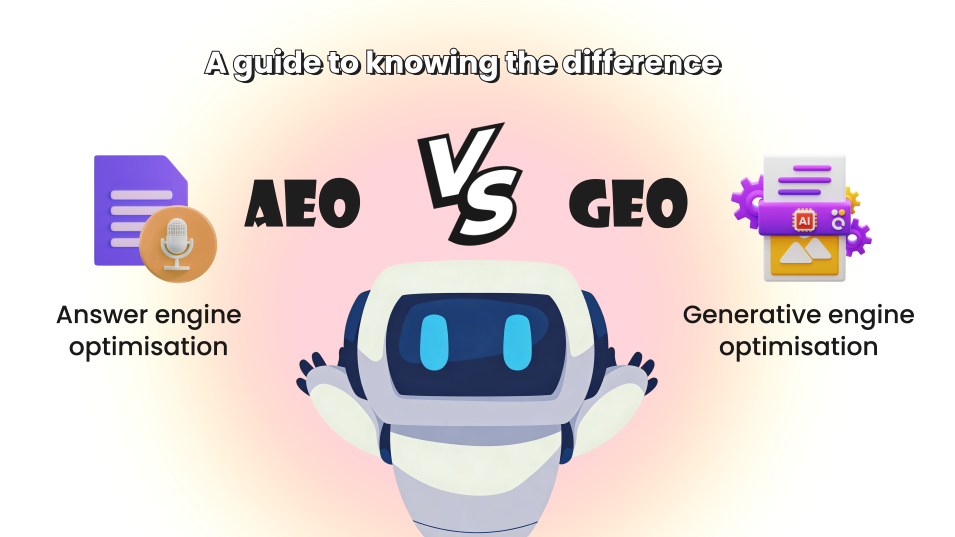
Around 80% of existing SEO best practices are still valuable and help increase your presence and opportunities to come up on AI models. AI answer engines are changing how people search, with roughly 77% of users already treating AI software as a search tool. It’s important to understand that Generative Engine Optimisation (GEO) structures content so AI can crawl, trust, and reference your content. Answer Engine Optimisation (AEO) focuses more on delivering direct answers that come up in featured snippets and AI generated overviews. It’s important to note that both GEO and AEO build on traditional SEO rather than replacing it.
Move over SEO, there are new sheriffs in town, and their names are GEO and AEO.
For many marketers and businesses, ranking on the first page of Google has always been the pinnacle of success – the badge of honour that comes with surviving the ever-evolving digital landscape. However, with the introduction of LLMs like ChatGPT and Gemini in recent years, the landscape is looking quite different, and businesses are having to adapt their content to ensure it’s getting indexed by AI answer engines too.
As attention spans become shorter and dopamine hits require instant gratification, users are no longer typing in a few keywords in Google, they’re asking AI models full questions to get direct answers. According to research from Adobe, around 77% of people are using ChatGPT as a search engine. AI is becoming a key traffic driver for many businesses, and answer engine optimisation (AEO) and generative engine optimisation (GEO) will help businesses align with this shift.
If you’ve just figured out what search engine optimisation is and how to implement it into your digital marketing strategy, it’s now time to add a few more acronyms to your vocabulary: generative engine optimisation (GEO) and answer engine optimisation (AEO).
What is GEO?
Generative engine optimisation, or GEO, is the process of structuring your content so it’s better understood by AI-powered search engines. This allows AI models to crawl your website and perhaps allows your content to become a trusted source for AI systems. As AI Overview becomes a more popular option and users turn to ChatGPT for answers, GEO can help your business appear in AI-generated answers, helping your business remain visible beyond traditional Google ranking systems.
What is AEO?
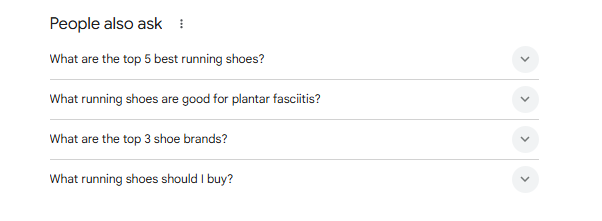
Answer engine optimisation (AEO) is about creating content designed to directly answer user questions, so it can appear on the featured snippets and AI-generated responses. AEO is about creating content that answers questions in a way that’s straight-forward without giving a long-winded answer. This makes it easier for Google and AI crawlers to crawl your content, understand the questions you’re answering, and feature your page in snippets, People Also Ask boxes, and AI-generated overviews.
Will AEO and GEO replace SEO?
Traditional search engine optimisation isn’t going anywhere anytime soon. In fact, the introduction of AI Search will only lead to the evolution of SEO, not the extinction .
According to Search Engine Land: “about 80% of SEO best practices remain relevant for AI-driven visibility.”
Based on this, SEO remains the foundation for ranking well on both Google and AI-driven platforms. Search engines still rely on keywords, backlinks, site structure, and technical optimisation to determine authority and relevance. However, on its own, SEO is no longer enough. As the digital landscape continues to evolve and more users turn to AI for answers, optimising just for Google and not factoring AI into the equation is doing your business more harm than good.
According to SOMS Digital’s Company Director, Glynn: “Users use AEO and GEO for an excellent starting point which often leads users to search for brands in the search engines after.”
E-E-A-T is your secret weapon
Whether you’re trying to optimise your website for AEO, GEO or SEO (it’s a mouthful, we know), it all comes down to creating and structuring your content in a way that allows AI and Google’s crawlers to understand what your website is about.
If you’ve dived into the world of SEO and content, then you’ve probably come across Google’s E-E-A-T framework: Expertise, Experience, Authority and Trustworthiness.
These are key factors that help Google and AI determine the quality and reliability of your content.
Experience: This gives your audience authentic insights and advice. First-hand knowledge on the subject matter signals to users and algorithms that you know what you’re talking about.
- SEO: It boosts engagement because it offers authenticity
- AEO: Provides practical answers and information
- GEO: AI models can confidently pull your content because it provides authentic and not generic advice.
Expertise: This often refers to the knowledge and credentials. This might be citations or a writer bio that shows your credibility. Citations can also be proof to support your content. Link out to experts and high-quality sources where possible.
Authoritativeness: This is your reputation as a reliable source. This could be anything from credentials, citations, and mentions from other sources.
Trustworthiness: Ensure your website is secure, has up-to-date information, and has relevant sources listed. Clear contact information, author bios, and privacy policies are important.
“Great SEO equals great AEO and GEO.”
“Content uniqueness is important, so remember that AI, so far, has no experience and it can only provide answers or put answers together based on what already exists on the web,” explains Glynn.
In summary:
- Keep things straightforward. Remember, no fluff. “Answer-first” content does well.
- Don’t forget citations. Link out to experts and high-quality sources where possible.
- Make content easy to read and scan. Lists, how-to’s and tables are good.
- Ask questions your audience is asking. Try and anticipate which questions your audience may be wanting to know.
- Use clear headings and subheadings that include clear questions and key phrases.
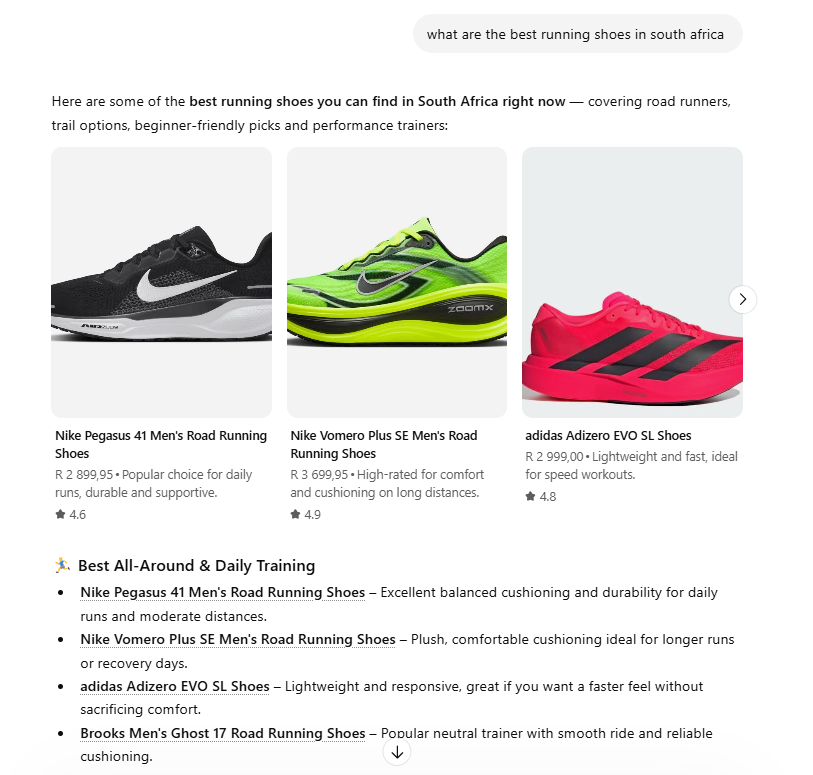
Here’s a good example of answer-first content:
For example, your first inclination is to give a little backstory to the question, right?
What are the best running shoes in South Africa?
Your knees are aching, your shins are splitting, and your heels are falling apart – it’s time to find a new pair of running shoes, but with so many good brands out there, which ones are you choosing?
Unfortunately, you’re going to need to be straightforward if you’re looking to rank for AI search. So, no fluff!
An alternative may be:
The best running shoes depend on your needs, but some of the best options include Nike, Asics, Brooks, and New Balance for comfort, support, and performance.
If you have a really good running shoe brand, you may want to throw yours into the mix.
Why does it matter for your business?
Users are no longer typing the same kinds of questions into Google as they are into AI tools like ChatGPT. As a result, search is shifting towards AI-driven results, with features like Google’s AI Overviews already reflecting this change.
While traditional SEO is far from dead, businesses need to adapt to this new era of customer behaviour. As search evolves, AEO and GEO represent the next step in content and search optimisation.
This shift is driven by changing user expectations. Modern audiences want fast, direct answers. AEO and GEO are designed to meet this demand, giving brands more opportunities for visibility, traffic, and engagement.
To stay competitive, brands will need to future-proof their digital marketing strategies by adapting to how AI systems interpret and surface content.
Speak to SOMS Digital today to future-proof your visibility in an AI-driven search landscape.