Vibe coding lets anyone turn a “plain-language” prompt into a working app in minutes, but building something that works is not the same as building something that’s ready for your customers. We tested this ourselves by prompting a travel budgeting app in 15 minutes, only for our developers to find broken calculators, and incorrect forex calculations. The lesson here is that AI tools are great at prototyping and testing ideas, but they can’t replace the security, architecture, and scalability needed for a product that’s ready to go live. The future of app building isn’t AI versus developers, but developers working with AI.
The age of artificial intelligence has been labelled the Wild West — and rightfully so. Large language models have pushed the boundaries of what we once thought was impossible, from animating static images to now generating fully functioning apps in a matter of minutes.
As a writer, the introduction of AI models like ChatGPT and Perplexity has helped speed up the creative process, but it’s also introduced new challenges in how content is created and evaluated by audiences.
What AI is capable of is expanding, which only adds fuel to the fire of an ongoing debate around both the advantages and limitations of AI in creative and technical work.
This time, however, AI and software engineering are being put under the microscope as tools like Base44 and Google AI Studio make it possible for almost anyone to build functional apps using simple, natural-language prompts. This shift has given rise to a term that has been growing in popularity – vibe coding.
What is Vibe Coding?
Vibe coding is a term first coined by AI researcher, Andrej Karpathy who had this to say about it: “There’s a new kind of coding I call ‘vibe coding’, where you fully give in to the vibes, embrace exponentials, and forget that the code even exists.”
Instead of writing code line by line, you describe what you want in plain language and simply let AI generate the app for you. You can build full app structures from prompts and create UI and backend logic automatically. It’s a good way for non-developers or early-stage founders to turn their ideas into apps that work. This allows them to focus their time and energy on the creative aspects rather than the technicalities of app development.
The idea of building an app as someone who only writes content, not code, was intriguing. I was interested to see how these tools could take a real-world problem (at least a problem in my world) and turn it into something tangible.
I’ve Built an App Using AI
These AI app-generating platforms promise to build anything in minutes. Who wouldn’t want to give it a try?
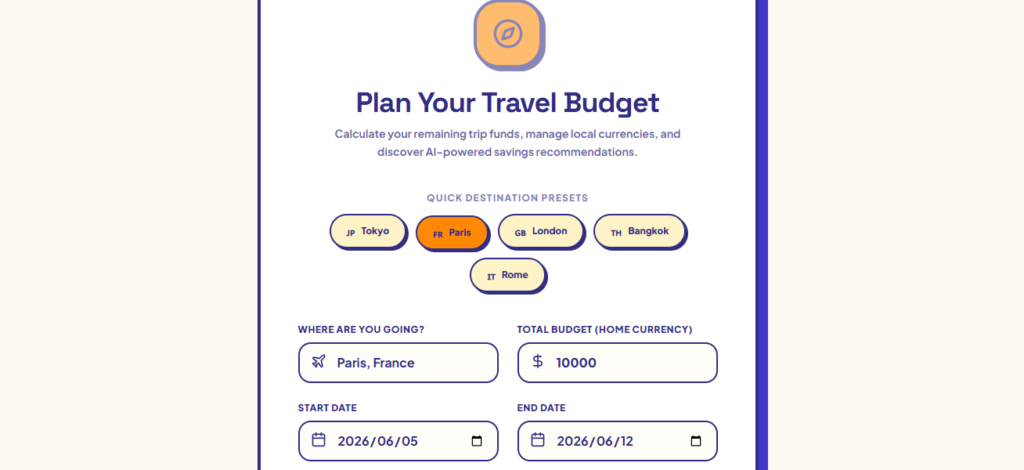
The prompt was simple: Build a travel budgeting app that allows users to set a total budget for their trip and then track their spending across different categories. Users should be able to input expenses as they go, with breakdowns across categories including food, accommodation, transport, activities, souvenirs, shopping, and other miscellaneous costs.
15 Minutes later, I had a functioning app. Immediately, there were a few tweaks I wanted to make. As a South African travelling abroad, it’s not always easy constantly shifting between euros/dollars and rands, so I wanted to ensure my budgeting app could handle that. I simply typed a prompt allowing users to set their budget in ZAR and switch between different currencies if needed, then hit enter. A few minutes later, my app was now able to switch between ZAR, Dollars, Euros and so much more.
What stood out to me the most from this experiment was just how easy the process felt. But maybe it was a little too easy.
Why Vibe Coding Is Actually Incredible
One of the biggest advantages of vibe coding is how quickly it allows an idea to move from concept to a working product. You don’t have to spend weeks or months in planning, development, and onboarding processes, non-developers can now have a minimum viable product almost immediately. As a non-developer looking to dip their toes into the world of app building, this is an excellent opportunity to know if you have a viable product without investing substantial time or money into the prototyping phase.
Traditionally, building an app without coding experience means you’d have to explain your idea to a developer, translate business logic into technical requirements, and go through multiple rounds of back-and-forth before having anything functional. AI tools allow creators to skip over this all together, and see their ideas take shape in real life. When I explained what I wanted to do to our head developer at SOMS Digital, Darren, I loved what he had to say about vibe coding:
“Building a vibe-coded app doesn’t require you to be a problem solver, you just need to be a problem-identifier.”
This makes vibe coding a powerful tool for founders and hobbyists who have a clear understanding of a problem they’re facing in their industry, but don’t have the technical wherewithal to “solve the problem” without extensive help.
Three years ago it would’ve been unimaginable to think a writer could create an app without learning code. Now, AI tools have eliminated one of the biggest barriers in software development – the gap between having an idea and being able to execute it.
The Point Where Things Start Breaking
As a newbie vibe-coder, the app passed my test. AKA: It worked, and it did everything I needed it to. Just in case, I wanted a software developer to have a look and see if it passed their test.
Spoiler: it did not. It took less than 10 minutes for Lesedi, SOMS Digital’s resident software developer, to have a look at my app’s code and see several problems. The first was a broken duration calculation. This meant that every user’s daily spending allowance would be wrong from the moment they set up their trip. Essentially, users would think they have enough breathing room to spend when the reality was that they would be overspending without the app warning them. This was no bueno, especially when you consider this was the entire reason I created this app – to not overspend!
Next, there was a hardcoded date which saw the “days remaining” and trip status frozen in time. Any user setting up a trip after this date would see incorrect countdown timers, wrong “On Trip – Day x” labels, and a daily allowance calculated against the wrong number of remaining days.
And last but not least, the exchange rate appeared to be coming from an LLM rather than a real FX API, meaning conversion figures could be incorrect. For a user converting ZAR to EUR for a big trip, even a small rate error compounds across the entire budget and gives a false sense of financial security. Again, this was not a good thing for someone like me, who counts every penny when travelling.
My biggest takeaway? Many of the bugs spotted by Lesedi were sneaky, hidden behind code that I would never have been able to identify if I didn’t know what to look for. While Google AI Studio would have been able to fix some of these bugs, my conclusion is that it would be impossible for me to present a functional app without some form of coding knowledge.
The next question then becomes: What happens when you don’t have a software developer to pop a Teams message to? It’s clear that there’s a much bigger gap between building something that works and building something that is actually ready for real-world use. And that gap is often underestimated in vibe coding.
The Biggest Myth of Vibe Coding
A common misconception around vibe coding is that AI can replace actual software development expertise. It’s an easy assumption to make, and clearly one I was willing to make thanks to those Base44 YouTube ads. While AI tools are great at developing “working” apps in minutes, they can’t replace proper software engineering. AI struggles with the deeper layers of software development, as it lacks the ability to fully understand architecture, security implications, and long-term scalability. These are not just “nice to have” considerations; they are essential for any app that needs to operate reliably in the real world.
Without these oversights, apps often become unstable, difficult to maintain, or vulnerable to exploitation. Another misconception is that you don’t need a basic understanding of code to launch a vibe-coded app onto the market. The reality is that you do need to understand what your code is doing and why. Darren had this to say about it:
“On the parts of the internet where developers like to hide, there are daily posts about vibe-coders receiving insane bills for API usage because their API key was exposed and abused, or an AI deleting a production database and all backups of the database. In the show Silicon Valley, Gilfoyle’s AI (The Son of Anton) is tasked with fixing a software bug. The Son of Anton decides that the best way to fix the bug is to permanently delete everything – if the software doesn’t exist then the bug doesn’t exist. This has become a very real scenario and is happening at an increasing rate. ”
The security risk is huge. A recent study of around 380,000 publicly accessible vibe-coded assets found that about 5,000 of those apps exposed corporate and personal information, including hospital work assignments containing doctors’ personal identifiable information, go-to-market strategy presentations and financial records. Without a developer reviewing the system, AI-generated code can unintentionally expose sensitive data or create vulnerabilities that can be exploited.
Ultimately, the biggest misconception around vibe coding is not that it doesn’t work – it clearly does, but that it works too well, too early. It creates the illusion that the hard part is over, when in fact, the most important work still needs to be done.
The Missing Middle: From MVP to Market
A minimum viable product (MVP) is the most basic version of an app, designed to include only the essential features needed to validate an idea before investing heavily into full development.
The challenge is that most people think having an app “that works” is the same as an app that’s “production-ready.” Most vibe-coded apps fall apart when moving from MVP to market because, while AI tools can create a functioning app, it doesn’t ensure that the underlying code is structured in a way that enables long-term use.
But that doesn’t mean vibe coding platforms don’t serve a valuable purpose in the development process. They do a good job of: rapid prototyping, idea validation, lowering barriers to entry, and removing friction between idea and execution. However, it’s missing the software engineering layer that production demands: security, scalability, system architecture, performance optimisation, testing, and long-term maintainability.
This gap only becomes obvious when a prototype moves beyond the MVP stage and into a real production environment that exposes it to real users, real data, and real-world functioning.
There are countless Reddit posts and articles highlighting the shortcomings of AI-generated apps, with security being one of the biggest concerns. When I spoke to Darren, this was something that he mentioned repeatedly, citing security vulnerabilities and “spaghetti logic” as some of the main reasons vibe-coded apps fail once they move beyond the MVP stage.
“If a proper developer isn’t brought in at the MVP phase, we normally see the project fail,” says Darren.
Okay, let’s hypothetically say you think you’ve done a good job of reviewing the code and you’re ready to launch. This is usually the next hurdle that kills any desire to complete the project. Code reviews, security checks, and testing all need to be done to ensure the app is stable, secure, and ready for real users.
Then comes app store submission. A process many first-time builders underestimate. For both the Play Store and App Store, developers are required to:
- Create a developer account (Google Play: one-time $25 fee, App Store: $99/year)
- Build and sign a release version of the app
- Set up the app listing, including screenshots, descriptions, categories, and privacy policies
- Submit the app for review (Google usually takes 1–3 days, while Apple can take up to a week)
- Address any rejections and resubmit if necessary
If you’re able to make it through this verification process, marketing is usually the next challenge. If you’ve managed to survive this, sustaining your app is where many vibe-coded apps end.
So, what’s the best option for vibe-coders looking to take the app beyond the finish line?
Get a developer to look at your app’s code and start rebuilding.
“The process doesn’t take as long as you would think. We can see the functionality you want, we can see the logic that has been used – we have everything we need to take your vibe-coded app from the MVP phase to launch-ready. We rewrite the spaghetti into clean code, we don’t leave any backdoors open, we make sure your app doesn’t only keep you safe, but also your intended users, says Darren.”
The truth is that while AI tools are marketed as an easy way to create apps, taking it from prompt to functioning application is a different challenge altogether. This “missing middle” is usually where the real work begins.
The goal is not to replace what has already been built, but to bridge the gap between idea and execution. To take what is often a promising but fragile MVP and turn it into something that’s stable, secure, and ready for real users.
The Takeaway
My own experiment taught me that these tools are promising powerful results without the need for developers, when the reality is, you do still need a developer. AI can be a good way to create apps if you’re just “messing around” but when it comes to developing an app that actually works for your business, it can become a mess.
Navigating the ever-evolving world of AI can feel like you’re making your way through a maze where the path keeps shifting as new tools and capabilities emerge on a daily basis. The uncertainty about the future is palpable, but this experiment has proved one thing: the future of vibe coding is not AI vs developers, but AI plus developers.
At SOMS Digital, we help bridge the gap between rapid AI-generated prototypes and production-ready applications that are secure, scalable, and ready for real users, along with supporting the marketing and launch strategy needed to make your vibe-coded app a success.
Get in touch with our Digital Agency to find out more.