
AI is changing how people search, but it hasn’t replaced the fundamentals of SEO, it’s simply built on top of them. AI tools pull answers from the same indexed web data as traditional search, meaning a site that’s invisible on Google is unlikely to surface in AI results either. Rather than chasing trends like “AI-friendly content”, fake brand mentions, or llms text files, businesses are better served by focusing on what has always worked, crawlable websites, strong internal linking, and genuinely valuable, expert-driven content.
It seems that no matter which corner of the internet you find yourself in, someone has something to say about AI. Businesses have been in a frenzy trying to keep up as it continues to evolve and the way customers search for information changes with it. As search behaviour changes, businesses that fail to adapt risk losing visibility to those that do. “Just Google it” is increasingly becoming “ask ChatGPT”, and the numbers show just how significant this shift has become.
According to a study conducted by Boston Consulting Group, around 31% of surveyed consumers occasionally use AI in their purchasing journey, while 19% rely on it regularly, saying they will often trust products AI recommends them.
These statistics are not isolated. Yahoo Finance conducted research of its own, concluding that around 74% of shoppers use AI during the initial product discovery and research phase.
With numbers like these, it’s no wonder people can’t stop talking about AI. But for businesses looking to capitalise on the AI boom, it means coming to terms with even more acronyms — AEO, GEO, and SEO — just to name a few. While each promises to help your business stay visible in an increasingly AI-driven search landscape, knowing which strategies actually matter can feel like its own challenge.
So, is SEO still relevant?
A recent Clarity webinar I attended revealed that AI-driven searches are converting three times more than those from other platforms. It’s no surprise, then, that the question becomes whether digital marketing strategies such as Search Engine Optimisation are still relevant.
According to Google, the answer is simple: yes, and here’s why we agree.
Traditional SEO techniques provide the foundation from which AI search builds. AI models cannot generate information about a business out of thin air, it needs a public web of data to synthesize answers. Therefore, if your business is not showing up on search engines like Google, it’s unlikely they’ll pop up when someone asks ChatGPT a question.
“The best practices for SEO continue to be relevant because our generative AI features on Google Search are rooted in our core Search ranking and quality systems,” says Google.
In other words, Google’s AI features still rely on Search to find relevant information, using techniques such as retrieval-augmented generation and query fan-out to explore and connect information from different sources.
We already see this playing out in Google’s AI Overviews, which provide AI-generated summaries at the top of search results while linking to relevant webpages used to support the information. In other words, the websites that appear in traditional search still have an opportunity to be discovered through these new AI-powered search experiences.
What Google Says You Don’t Need To Do for AI Search
With the machine revolution moving like wild fire, advice can move just as quickly. Recommendations can turn into facts, which then evolve into myths, and myths aren’t always helpful when it comes to navigating the Wild, Wild West of AI. Here are a few things you don’t need to do to keep up:
Creating Snippets for AI
There’s a common misconception that you need to break your content into bite-sized pieces in order for AI to digest it. In reality, AI modes, like Google’s various systems, can understand nuance and advanced topics. The trick is to create content pages for your audience, not just for AI models.
Generating Inauthentic Mentions
It’s no secret AI models pull information from public sources, including platforms like Reddit. It may be tempting to manipulate information via these platforms to get your products or services mentioned, but ranking systems focus on high-quality content, blocking out spam. So keep that in mind the next time you feel like ingeniously totting your product on Reddit.
You Don’t Need LLMs.txt Files
LLMs.txt files are designed to help AI systems understand a website by providing a simplified overview of its content. However, Google states that you don’t need to be creating special files, including one specifically for visibility across AI platforms, to get noticed by AI search engines. A recent Ahrefs study of more than 137,000 websites found that 97% of existing llms.txt files received no requests at all during May 2026. This doesn’t necessarily mean llms.txt has no purpose. However, if your goal is to improve your visibility in Google AI Overviews or AI Mode, it shouldn’t be treated as a magic solution. There are more established SEO fundamentals worth prioritising first.
SOMS Take: Our Biggest Tip To Help Your AEO Efforts?
Create something worth finding. As someone who works with content here at SOMS Digital, this has been one of my biggest takeaways. Your audience is searching for value. They want to walk away learning something new. Whether that’s about how your product or service can help them, or 10 ways to make their garden prettier, if you can provide them with content that resonates, then you’ve won half the battle. The same goes for AI models. Yes, AI models are looking for content that skips the “fluff” and goes straight into the nitty gritty, but that doesn’t mean you should skimp on quality.
Content creation isn’t just about creating more content in order to be seen by users and AI. It’s about creating content that’s unique and compelling. Something Google has been preaching for the longest time is: “create topical authority.” This simply means, do you actually know what you’re talking about in order for us to put it in front of audiences?
Here’s how you can win over the hearts of people and machines:
Provide a unique point of view: For example, one of the ways I like to do this here at SOMS is by asking my colleagues their opinion on a topic. Researching is great, but when you have five other blog posts saying the same thing, it can become a bit repetitive. Add a unique perspective to your content through personal experience, client testimonials, and expert opinions.
Create non-commodity content: Again, you want to show that you’re the expert. Non-commodity content offers something that isn’t readily available across the thousands of blogs and websites on the internet. According to Google, it wants: “expert-led content that provides value beyond common knowledge.” Give real-world examples, practical tips that have helped you, and fresh angles on familiar topics.
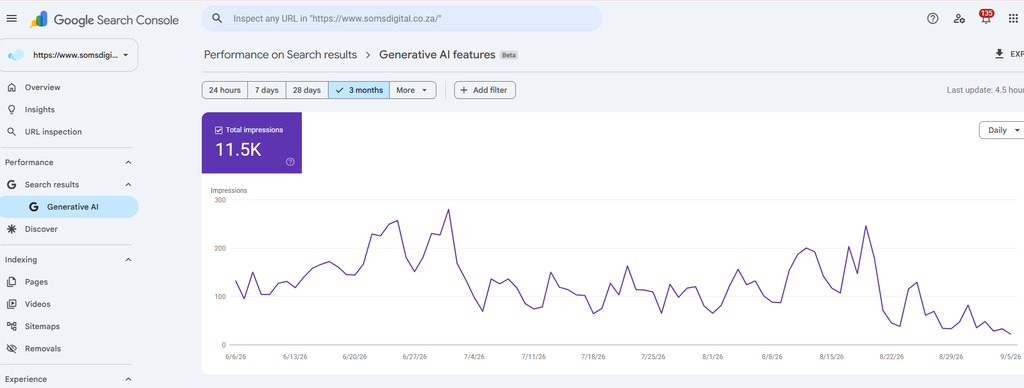
Our biggest, biggest tip: Use Google Search Console! In response to the growing reliance on AI, Google has now provided website owners with a Generative AI performance report. This won’t show how many clicks you’re getting, but it does show impressions and your site’s top pages that are showing up.
SEO is Not Dead, It’s Evolving
It can be tempting to follow every trend, especially if it could improve your business’s online visibility. There’s no doubt that AI search is changing the way we shop, with many of these customers being high intent. As a business adapting to this “new world,” it’s a good idea to focus on what search engines already value. Good technical SEO, crawlable/indexable websites, strong internal linking, and most importantly, valuable content.
The future of search isn’t about choosing between SEO and AI. It’s about building a strong SEO foundation while creating content that gives people and AI something worth discovering.
If you’re ready to dive into the world of AI and SEO, speak to our experienced digital marketing team today.